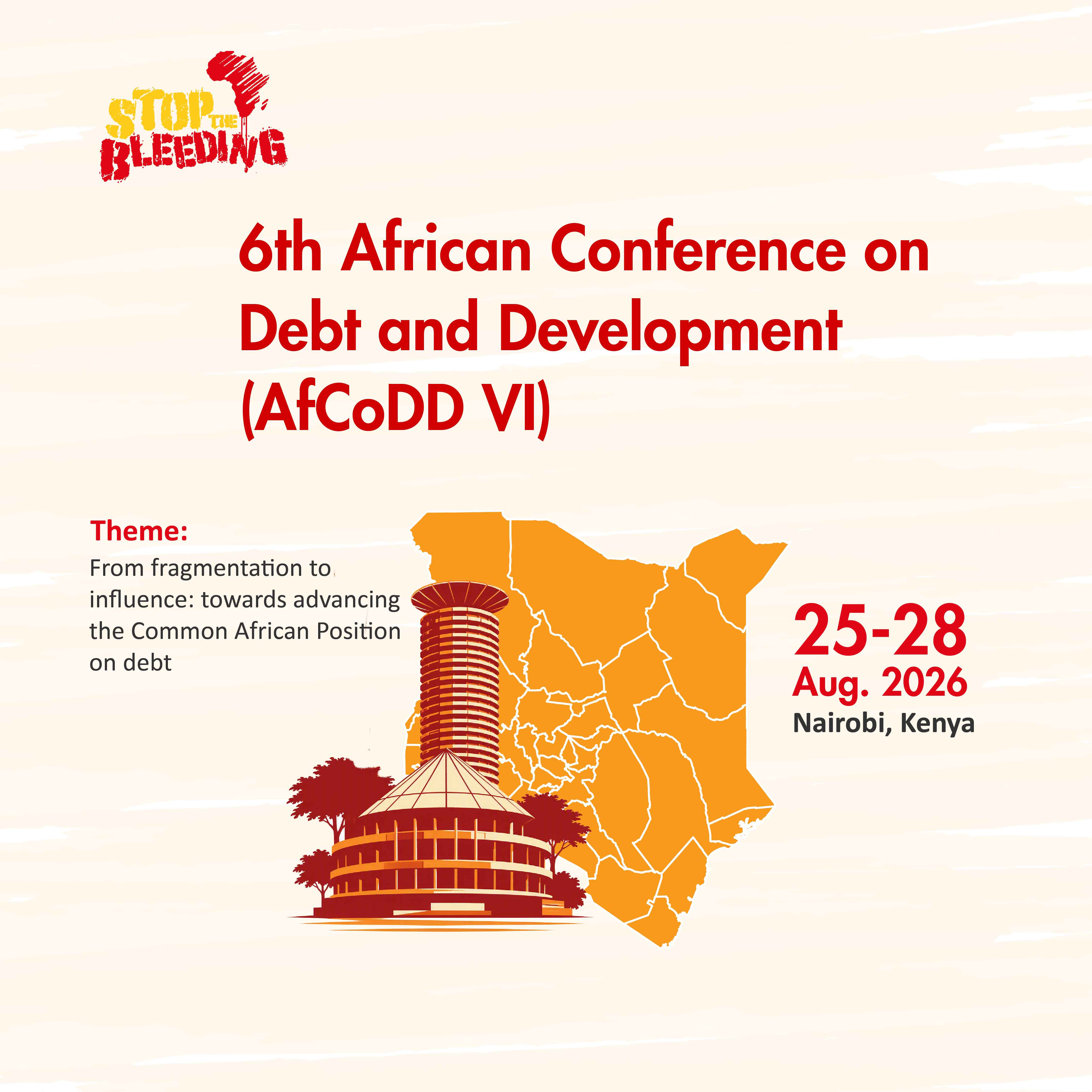

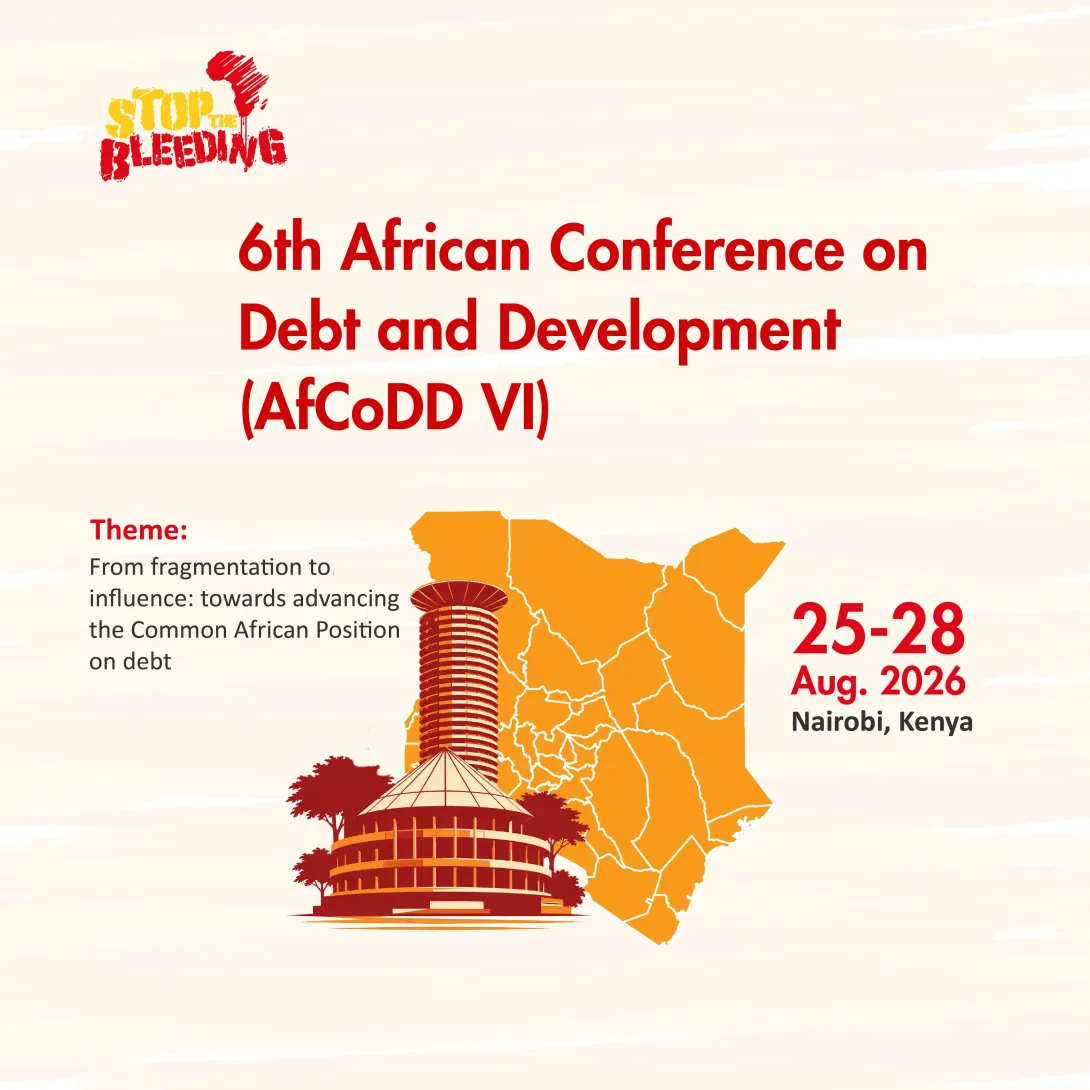
The 6th African Conference on Debt and Development (AfCoDD VI) will convene in Nairobi from 26 to 28 August 2026, bringing together African governments, civil society, researchers, parliamentarians, development finance practitioners, media, and other stakeholders to advance a more coordinated continental response to Africa’s debt crisis.
Held under the theme “From Fragmentation to Influence: Towards Advancing the Common African Position on Debt,” AfCoDD VI comes at a critical moment for Africa’s engagement with the global financial architecture.
The conference will focus on a defining question: How can Africa turn the Common African Position on Debt from a continental declaration into an actionable and politically consequential programme?
From a common position to collective action
Africa’s debt challenge has grown significantly over the past two decades. The continent’s total debt has risen to more than USD 1.8 trillion, while debt servicing continues to place significant pressure on national budgets and constrain governments’ ability to invest in health, education, and development.
At the same time, African countries continue to navigate an international financial system in which decision-making power and access to affordable finance remain uneven.
Against this backdrop, African governments have taken important steps towards strengthening the continent’s collective voice. Following the Lomé Declaration adopted after the inaugural African Union Debt Conference in 2025, African Union Heads of State and Government adopted the Common African Position on Debt in February 2026.
The Common African Position provides a continental framework for addressing both the immediate challenges of debt restructuring and the deeper structural weaknesses within the global financial architecture.
AfCoDD VI will build on this momentum by examining what is required to move from political commitment to implementation.
Building Africa’s leverage
The Common African Position on Debt is anchored around two broad pillars.
The first focuses on debt restructuring and reform of the global financial architecture, including reform of the G20 Common Framework, changes to credit-rating methodologies, the establishment of a UN Framework Convention on Sovereign Debt, a Borrowers’ Club, reforms to the Special Drawing Rights allocation system and stronger frameworks for engaging private creditors.
The second focuses on African agency and institutional architecture, including strengthening African financial institutions, scaling up domestic resource mobilisation, developing local-currency bond markets, establishing an African Debt Monitoring Mechanism and expanding innovative financing instruments.
For these proposals to deliver meaningful change, however, Africa will need sustained political coordination, stronger continental solidarity and the ability to collectively leverage its position in global financial negotiations.
AfCoDD VI will therefore ask: What is Africa’s collective leverage in the global debt architecture, and how can it be deployed to position the continent as a rule-maker rather than a rule-taker?
Three days of dialogue, strategy and mobilisation
AfCoDD VI will take place across three pillars.
26 August — Political Pillar:
The conference will bring participants together in plenary sessions to interrogate the key political and structural questions surrounding implementation of the Common African Position on Debt.
As part of AfCoDD VI, Tax Justice Network Africa, through the Stop the Bleeding Campaign, will convene a strategic session titled “Deploying the Continent’s Strategic Assets to rewrite the Rule of the International Debt Governance.” The session will position illicit financial flows, domestic resource mobilisation and Africa’s control over its strategic assets as central to the continent’s ability to reshape debt governance and strengthen its bargaining power in the global financial system.
Activity: Launch of the Stop the Bleeding Campaign’s Black Paper.
Location: Nairobi, Kenya
Date 26 August 2026
Time: 1430hrs–1600hrs
27 August — Research and Ideation:
Sixteen concurrent side sessions will provide space for researchers, practitioners and other stakeholders to explore diverse perspectives on debt, development finance and structural transformation.
Session: Critical Minerals, Debt and Tax Justice in Africa’s Common Position
Africa is central to the global energy transition, possessing vast reserves of critical minerals such as copper, cobalt, lithium, graphite and manganese. Yet many resource-rich countries remain burdened by debt, poverty, inequality and limited industrialisation.
As global demand for these minerals grows, resource-backed loans secured against future commodity exports have become an important source of financing for cash-constrained governments. While such loans can provide short-term liquidity and support infrastructure development, they also raise concerns around transparency, debt sustainability, fiscal sovereignty, commodity price volatility and the pre-commitment of future national wealth.
This session will examine the links between critical minerals governance, debt, tax justice, climate justice, inequality and resource-backed borrowing through the lens of the Common African Position on Debt. Participants will explore policy reforms that strengthen accountability, domestic resource mobilisation and value addition, while ensuring Africa’s mineral wealth supports inclusive development, economic transformation and long-term fiscal resilience rather than deepening debt dependency.
Panelist: Ishmael Zulu, TJNA
28 August — Public Mobilisation:
The final day will focus on building sustained civic momentum around the Common African Position on Debt and strengthening civil society engagement beyond the conference.
The conference will also provide an important platform for civil society organisations to develop strategies for monitoring implementation, strengthening accountability and building a coordinated pan-African movement around debt justice.
Africa must move from fragmentation to influence
For decades, African countries have confronted debt challenges within a global financial system that often limits their policy space and bargaining power. AfCoDD VI seeks to shift this dynamic by creating space for a stronger, more coordinated continental agenda.
The conference is not only about diagnosing Africa’s debt crisis. It is about identifying concrete pathways for action.
As Africa advances its Common Position on Debt, the challenge is to ensure that it becomes more than a statement of intent. It must become a basis for collective action, stronger negotiating power, and meaningful reform of global financial architecture.
For more information, please contact Tatenda Mzezewa via tmzezewa[@]taxjusticeafrica.net
