
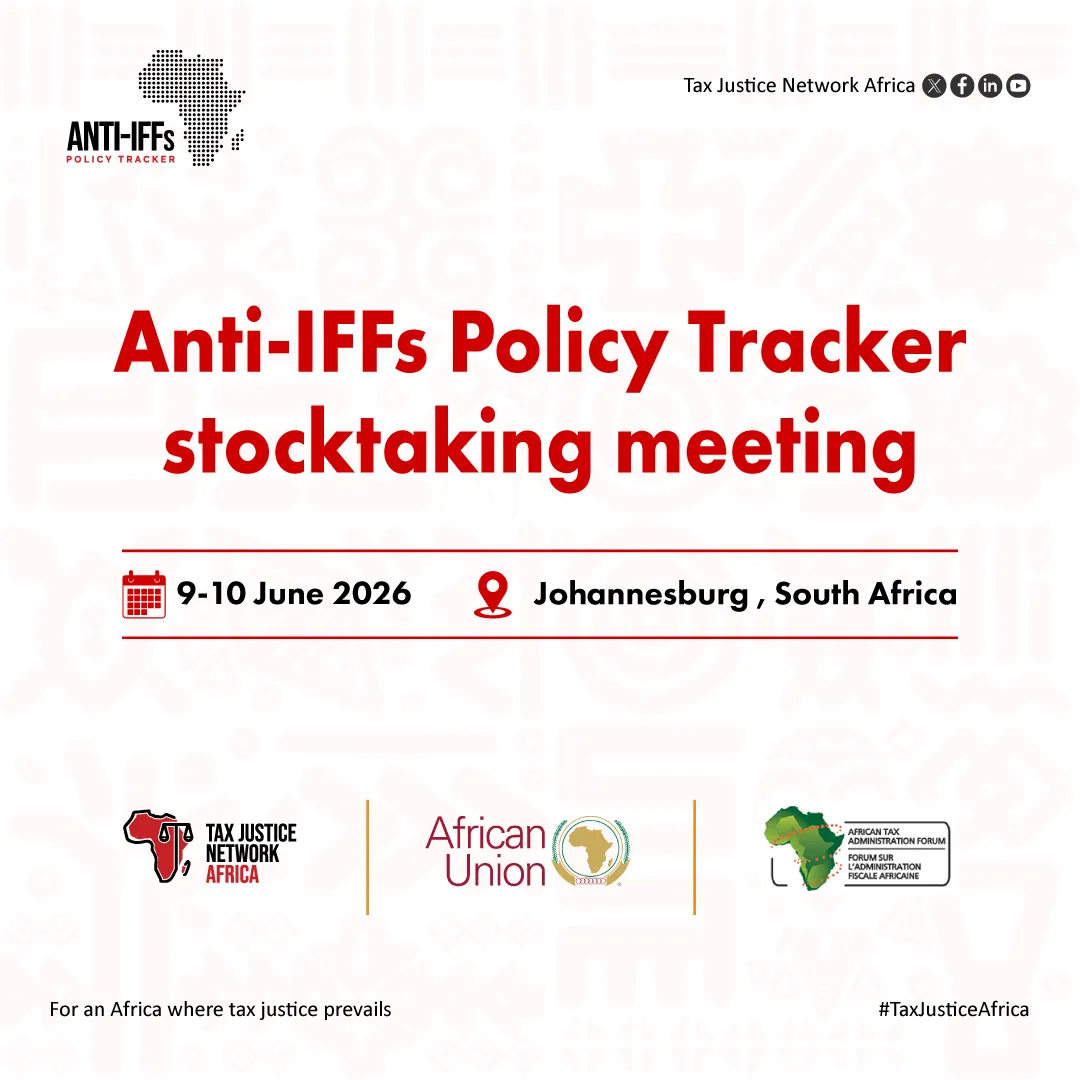
Tax Justice Network Africa (TJNA), in collaboration with the African Union Commission (AUC) through its Department of Economic Development, Trade, Tourism, Industry and Minerals (AU-ETTIM), and the African Tax Administration Forum (ATAF), will convene the Anti-IFFs Policy Tracker stocktaking meeting in Johannesburg, South Africa, on 9–10 June 2026.
The meeting marks an important milestone in Africa’s efforts to strengthen coordinated responses to illicit financial flows (IFFs), which continue to deprive the continent of critical resources needed to finance development, strengthen public services, and advance Agenda 2063 and the Sustainable Development Goals.
The stocktaking meeting will bring together representatives from pilot countries, regional institutions, development partners, technical experts, and policy practitioners to reflect on lessons from the pilot phase of the Anti-IFFs Policy Tracker and chart a pathway for its continental rollout. Participants will review country experiences, assess the tool’s effectiveness, refine its methodology, and validate approaches for future implementation across African Union Member States.
The Anti-IFFs Policy Tracker is an African-owned self-assessment and monitoring framework developed by TJNA, ATAF, and the AUC to support countries in evaluating the maturity of their tax-related anti-IFF systems. Organised around four interconnected clusters—policy and regulatory frameworks, institutional arrangements, information and data systems, and inter-agency cooperation—the Policy Tracker enables countries to identify reform gaps, assess progress, and prioritise actions to curb illicit financial flows.
The meeting follows the successful completion of pilot assessments in Namibia, Uganda, Ghana, Liberia, Côte d’Ivoire, and Zambia. These pilots provided valuable insights into the strengths, challenges, and practical application of the Tracker, generating evidence to support its refinement and broader adoption across the continent.
Expected participants include representatives from pilot country tax administrations, financial intelligence units, ministries of finance, the Deutsche Gesellschaft für Internationale Zusammenarbeit (GIZ), the African Organization of Supreme Audit Institutions (AFROSAI), the African Organization of Public Accounts Committees (AFROPAC), the University of the Witwatersrand, the African Development Bank (AfDB), the United Nations Development Programme (UNDP), the United Nations Economic Commission for Africa (UNECA), the African Peer Review Mechanism (APRM), Open Ownership, and other technical partners and experts.
Discussions during the two-day meeting will focus on strengthening the design and methodology of the Policy Tracker, improving evidence and quality assurance standards, reviewing the operational manual, identifying ways to translate assessment findings into national reform roadmaps, and agreeing on governance arrangements for continental implementation.
The meeting will also provide a platform for peer learning among pilot countries, allowing participants to share experiences, good practices, implementation challenges, and reform priorities. The outcomes will inform the final refinement of the Policy Tracker, support the development of a continental rollout roadmap, and strengthen African-led efforts to combat illicit financial flows through coordinated, evidence-based action.
By the end of the meeting, stakeholders are expected to reach consensus on key improvements to the Tracker, validate the Anti-IFFs Policy Tracker Manual, agree on mechanisms for using assessment results to support national reforms, and endorse a practical strategy for scaling the tool across Africa. The outcomes will contribute to ongoing African Union efforts to strengthen transparency, accountability, domestic resource mobilisation, and sustainable development, while informing future reporting and policy discussions under the AU Specialized Technical Committee on Finance, Monetary Affairs, Economic Planning and Integration.
The stocktaking meeting represents a critical transition from pilot testing to institutionalised continental implementation, reinforcing the role of African-led solutions in addressing illicit financial flows and strengthening the continent’s capacity to mobilise domestic resources for sustainable development.
For more information, please contact Aya Douabou at adouabou[@]taxjusticeafrica.net.
