



“Injustice anywhere is a threat to justice everywhere,” said Martin Luther King. Yet for over 100 years, the global financial system, through both law and practice has perpetuated an injustice of eroding the taxing rights of some countries over others. This historic wrong desperately needs rewriting.
So how do we begin again? By considering what is most fundamental in this process. This will involve considering the principles of dignity, equality and fairness.
With the remembrance that the United Nations (UN) was born on the heels of war and the resulting need, as set out in Article 1 of the UN Charter, to respect the principle of equal rights and the self-determination of people, to achieve international cooperation to solve global problems of an economic, social, cultural, or humanitarian character, to promote and encourage respect for human rights and for fundamental freedom for all without distinction and to recognise the UN as the place for harmonising the actions of nations in the attainment of these common ends. We must acknowledge that taxation provides a source of revenue to realise all human rights.
This reinforces the UN's role as the legitimate centre of international tax policy making other de facto elite stakeholders, such as the OECD. It also reiterates the primacy of the well-being of humans as genuine rights holders and of peoples (ie. the collective) over the “rights” of businesses (who are often called “taxpayers”) in the negotiations for a UN Framework Convention for International Tax Cooperation (UN Tax Convention).
To pursue a human rights framing in international tax policy and in any public policy is to prioritise genuine equality and fairness whilst adopting an intersectional approach to addressing structural discrimination.
Bridging the ‘discord’ between human rights approaches and fiscal policy
It is notable that the negotiations on the UN Tax Convention are led by tax experts. For this reason, sometimes, there may be discord between a human rights approach and a fiscal approach to the negotiations. This raises the question: Are we speaking the same language? There are in fact, several similarities between these two schools of thought. For instance, in fiscal policy, we talk about cost-benefit analyses, in human rights, we talk about human rights impact assessments. In fiscal policy, we talk about tax incidence and poverty reduction, in human rights, we talk about the principles of equality and non-discrimination.
In fiscal policy, we talk about the fiscal space – the capacity to mobilise resources for policy objectives. In human rights, we talk about the duty to generate the maximum available resources to realise human rights. The ideas are similar, but the vocabulary is different. Both lead to the same results. We can lose each other by not being familiar with each other’s terminologies and by not being aware that the human rights framework can serve not only tax justice ends but also human rights ends.
A human rights approach to ‘fairness’
Fairness is a central concept within the UN Tax Convention. It is mentioned in the proposed objectives, principles and commitments of the UN Tax Convention. Considering the mention of establishing ‘a fair international tax system’ and ‘fair allocation of taxing rights’, a question arises: What does fairness entail?
Fairness is both substantive and procedural. Taken broadly, the human rights principles of transparency, accountability and inclusive participation address the different forms of intersectionality and therefore aspire to achieve fairness for all groups. ‘Fairness’ interrogates how decisions are made and whether outcomes are equitable. Fairness in the reallocation of taxing rights under a human rights framework entails:
Reparative justice objectives
Since before the establishment of the UN, Global South peoples have been agitating for economic sovereignty including structural change as restitution for historical exploitation. They have been agitating for fairer trade terms, regulation of multinational corporations to protect developing economies, transfer of technology and access to industrial know-how, sovereign control over natural resources and reform of international financial institutions to reflect Global South priorities. A UN tax convention which serves the interests of the Global South, is itself, a form of reparations through structural change.
Climate justice objectives
In 2022, the UN General Assembly recognised the right to a clean, healthy, and sustainable environment as a universal human right. A tax system which ensures more taxing rights are shifted towards developing and climate-vulnerable countries, that adaptation, mitigation and a just transition are adequately financed, and that colonial economic legacies and unequal global value chains are corrected addresses the harm of climate change by holding those most responsible for it, to bear the greatest burden for it. Climate justice through tax justice is an intergenerational equity issue and a sustainable development and just transition issue (reducing the reliance on aid), and seeks to achieve redistribution, repricing as well as systemic change.
Gender justice objectives
The adequacy of revenues for public services affects those who rely on public services the most such as women and girls. It affects those who pay for its non-provision by undertaking care and domestic work as well as those who disproportionately bear the burden of taxation as a result of reduced revenues due to tax avoidance and evasion.
Fairness in the rules about the allocation of taxing rights means inclusiveness and proportionality with regard to the objectives we seek to pursue including the capacity to pay taxes and the consequential impact on payers.
How can fairness be enforced in practical terms? It starts by piercing the corporate veil. Companies are legal constructs which have become increasingly complicated, obscure and opaque. These structures are used to aggressively avoid, if not evade, their true tax liabilities. We cannot get a full sense of what a company owes without knowing l of its tentacles (subsidiaries) and activities – some of which only appear to exist for the purposes of limiting its liabilities (such as through transfer mispricing). Understanding where multinational corporations pay tax (and how much they pay) will help us to evaluate how taxing rights are being allocated and further evaluate whether this allocation is fair or not.
The fundamental human rights principles of transparency, accountability and participation underpin the demands from global majority states and civil society for strong treaty provisions on beneficial ownership, asset registers for high net-worth individuals, public country-by-country reporting and the effective exchange of information for tax purposes. It is only when we have a comprehensive picture of where wealth lies and income is derived that we can effectively address illicit financial flows (IFFs) and harmful tax practices and fairly allocate taxing rights.
It means that the thresholds, formulae, definitions and effective tax rates among other tax rules shall consider human rights impacts particularly, on lower-income groups and countries, acknowledging that the right to development is a collective goal and that we can and should apply the principles of non-discrimination, intergenerational equity and accountability.
The centrality of extra-territorial responsibility
In international human rights law extra-territorial obligations are derived from the principle of international cooperation and assistance, the idea that fulfilling economic and social rights is a shared global responsibility, not just a domestic one; that international cooperation is necessary to solve global economic and social problems; that states have a duty to cooperate because every human person and all peoples have a right to participate in, contribute to, and enjoy economic, social, cultural and political development, in which all human rights and fundamental freedoms can be fully realised - ie. the right to development; and that wealthier states should support lower-income states to realise rights including through aid, debt relief and fair global economic rules (including taxation).
With regard to international taxation, this means states should refrain from actions which would impede other states from realising their own obligations including generating their maximum available resources, including from taxation, to realise human rights. Extra-territoriality in international taxation also concerns how states can tax persons and entities beyond their borders but also cooperate towards common goals such as the elimination of illicit financial flows.
The legally binding Charter of the Economic Rights and Duties of States provides for the right of every state to economic sovereignty including equality between nations and protection against economic domination. Specifically, it provides for sovereignty over natural resources, the right to choose economic systems (ie. there should be no coercion such as sanctions or pressure), regulation of multinationals, fair international trade, international cooperation and development and the duty to do no harm to other states.
Stagnation in negotiations
And yet, over and over, we hear in the UN tax negotiations, of the practical difficulties of undoing what already exists – such as renegotiating double taxation agreements and other mechanisms. Even if we recognise such challenges, they do not invalidate the need to adhere to fundamental human rights principles. We need to move on from why we can’t do this to how we can. Merely reiterating existing practices in international taxation that are difficult to undo only serves to stall or to distract from the Intergovernmental Negotiating Committee’s mandate and programme of work on the relationship of the convention with other agreements, instruments and domestic law.
It is not lost on the global majority that these repeated refrains by the global minority are intended to maintain a status quo which serves an elite – a historically colonial and presently neo-colonial elite. The G7 and OECD countries have used the UN and other multilateral spaces to vote and to act against redressing injustice in the writing and application of global financial rules. Many even voted against the resolutions proposing international tax policy making should be conducted at the UN and continue to act in bad faith in the negotiations to sabotage them.
Taxation is a human rights issue
Taxation is a human rights issue, a reparative justice issue, a feminist issue, an inter-generational equity issue, a climate justice issue and a development issue. Obligations towards these ends already exist and should guide the framing of the UN Tax Convention. While human rights law cannot always be prescriptive about the how – because human rights are about goals and obligations and minimum standards which can be achieved under a diversity of policy choices, it can very much be used to determine the what – in terms of what outcomes should look like.
In this present moment of transition to a more multipolar world carved up by competing great powers and fragmented globalisation and consequential threats to truly addressing tax injustice, we would do well to remember where we came from that resulted in the Universal Declaration of Human Rights in the first place, lest we find ourselves there again.
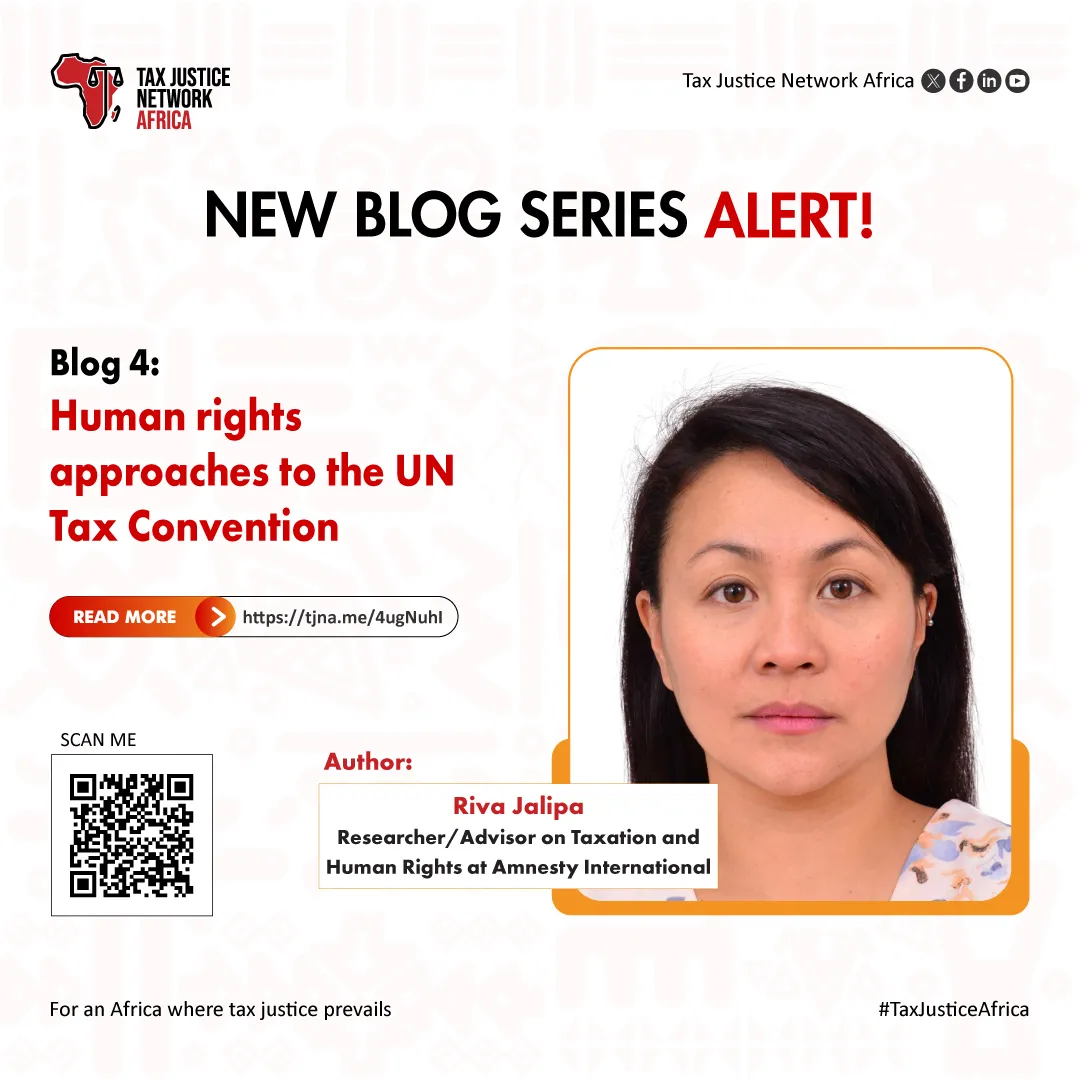
This blog was authored by Riva Jalipa, a Researcher/Advisor on Taxation and Human Rights at Amnesty International.
For more information, please contact Everlyn Muendo at emuendo[@]taxjusticeafrica.net.
